Telegram Gateway SMS API Pricing: A Complete 2026 Guide to Costs, Plans, and Best Uses
Telegram Gateway SMS API pricing has fundamentally changed what businesses pay to verify users online. Using Telegram Gateway is up to 50 times cheaper than traditional SMS verification, which often costs significantly more per message depending on the region. That single fact is reshaping how developers and product teams approach user authentication in 2026.
Key Takeaways
| Question | Answer |
|---|---|
| What does Telegram Gateway SMS API cost? | $0.01 per successfully delivered verification code, flat, regardless of destination country. |
| Is there a free tier for Telegram Gateway? | Yes. All codes sent to the developer's own phone number during testing are free of charge. |
| How does Telegram Gateway pricing compare to SMS? | It is up to 50x cheaper than traditional SMS verification services in 2026. |
| Do businesses pay for failed delivery attempts? | No. Businesses receive an automatic 100% refund for any code that is not delivered within the specified TTL window. |
| Does the price vary by country? | No. The $0.01 flat rate applies globally, eliminating regional pricing complexity. |
| Who is Telegram Gateway best for? | Apps and platforms with large or global user bases where traditional SMS costs are a significant operational expense. |
| How large is the addressable user base? | Over 950 million monthly active Telegram users can receive verification codes without downloading anything new. |
What Is the Telegram Gateway SMS API?
Telegram Gateway is an official API product from Telegram that allows businesses to send phone number verification codes directly through the Telegram app. Instead of routing a one-time password through a carrier's SMS network, the code arrives as a Telegram message.
For users already on Telegram, the experience is faster. For businesses, Telegram Gateway SMS API pricing makes the economics dramatically more favorable than any traditional SMS route.
The product is designed for developer integration. You call the API, specify a phone number and a Time-To-Live (TTL) window, and Telegram handles delivery. Your account is only charged on confirmed delivery.
How Telegram Gateway SMS API Pricing Actually Works
The pricing model is deliberately simple. There are no tiers, no monthly minimums, and no regional surcharges. You pay $0.01 per successfully delivered verification code.
That is the complete pricing structure. One flat number, applied globally.
Traditional SMS pricing tables often run dozens of rows, with per-country rates that vary from a fraction of a cent to well over $0.10 per message in high-cost markets. Telegram Gateway SMS API pricing eliminates that entire complexity layer.
Billing is performance-based by design. If a code is not delivered within your specified TTL, you do not pay. The charge only triggers on confirmed success.
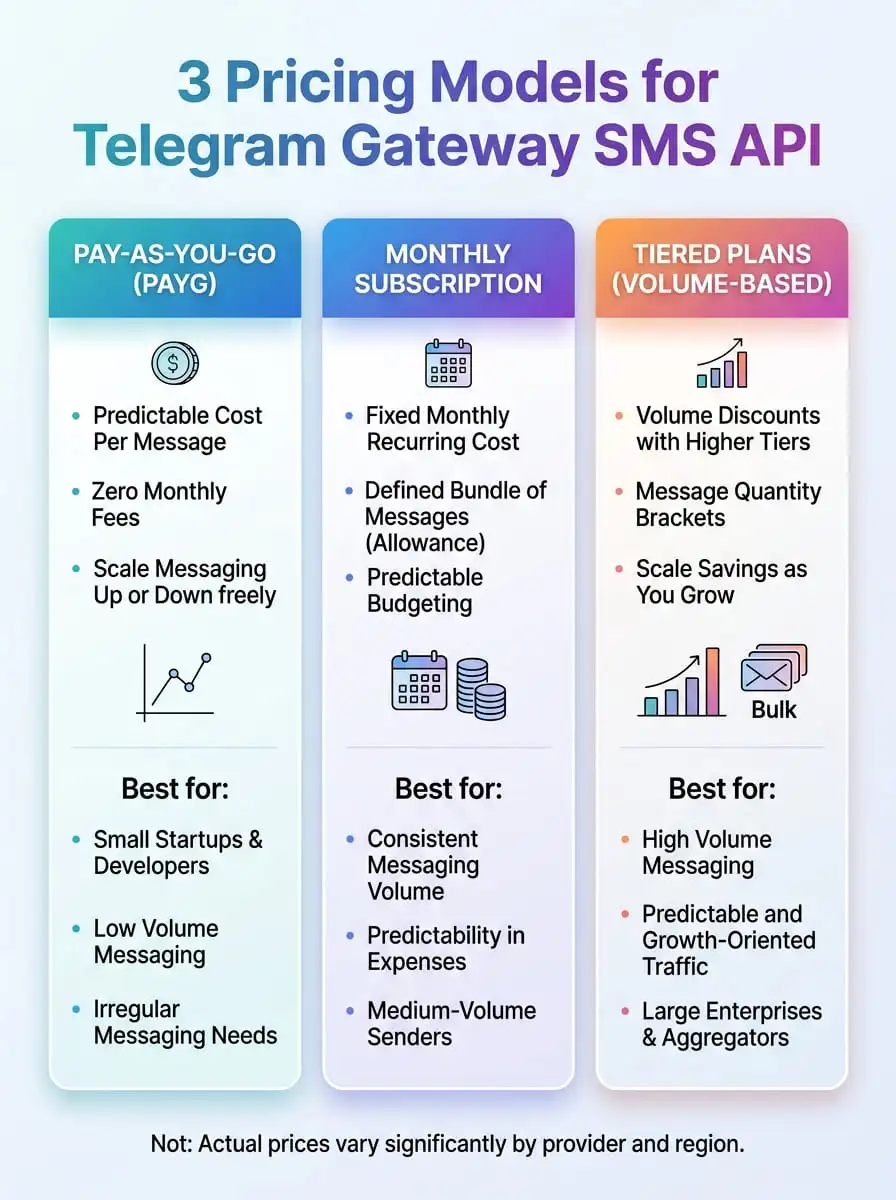
The $0.01 Flat Rate: Breaking Down Telegram Gateway SMS API Pricing
A single cent per delivery sounds almost too clean. Here is what that actually means in practice for a real product team.
If your app verifies 100,000 new users per month, your Telegram Gateway cost is exactly $1,000. No surprises. No invoice line items for "premium carrier routing" in certain regions.
Compare that to a mid-tier SMS API provider charging $0.05 per message globally. The same 100,000 verifications cost $5,000. That is a $4,000 monthly difference on a single cost line.
At 1,000,000 monthly verifications, the gap becomes $40,000. Per month. The savings compound quickly at scale.
Telegram Gateway SMS API Pricing vs. Traditional SMS Verification Costs
Traditional SMS verification has three cost problems. Regional pricing varies wildly. Carrier failure rates mean you sometimes pay for messages that never arrive. And pricing structures often obscure the real per-delivery cost under minimums and platform fees.
Telegram Gateway SMS API pricing solves all three directly.
The flat global rate removes regional unpredictability entirely. The success-only billing model means failed deliveries cost you nothing. And the pricing structure is a single number with no hidden platform layer.
Here is a direct comparison across common verification volumes:
| Monthly Verifications | Telegram Gateway ($0.01) | Traditional SMS (avg. $0.05) | Monthly Savings |
|---|---|---|---|
| 10,000 | $100 | $500 | $400 |
| 100,000 | $1,000 | $5,000 | $4,000 |
| 500,000 | $5,000 | $25,000 | $20,000 |
| 1,000,000 | $10,000 | $50,000 | $40,000 |
Traditional SMS verification can also experience failure rates as high as 5% due to carrier delays and network congestion. Those failed messages often still incur charges with many providers. Telegram Gateway's success-only billing removes that risk entirely from the equation.
Best For: Which Teams Should Prioritize Telegram Gateway SMS API Pricing
Telegram Gateway is not a universal replacement for every SMS use case. It works specifically for user phone number verification. And it only delivers to users who already have Telegram installed.
That distinction matters. Here is who gets the most value from the pricing model:
- High-volume consumer apps. Any product verifying hundreds of thousands of phone numbers monthly sees the cost difference immediately.
- Global-first products. Apps operating across multiple regions benefit directly from the flat global rate. No per-country pricing negotiation required.
- Startup teams managing burn rate. Replacing a $0.05/message SMS line item with a $0.01/message Telegram Gateway cost frees meaningful capital at even modest user volumes.
- Developer teams prototyping verification flows. The zero-cost testing environment lets developers build and debug without any spend.
- Security-conscious platforms. Telegram's encrypted delivery infrastructure offers a structural security advantage over unencrypted SMS.
The one firm prerequisite is Telegram installation on the recipient's device. If your user base has low Telegram penetration, a fallback SMS route remains necessary. Many teams use both.
Free Testing: Zero-Cost Development with Telegram Gateway
Getting started with the API costs nothing. Telegram Gateway offers a built-in 0-cost testing environment where all verification codes sent to the developer's own phone number are free of charge.
This is a practical detail, not a minor footnote. Verification flows require significant testing. Edge cases, retry logic, TTL configurations, and error handling all need iteration before production deployment.
Doing that iteration at no cost means the full Telegram Gateway SMS API pricing advantage begins the moment your first real user verifies. Not earlier, not after a testing budget is consumed.
Most traditional SMS verification providers charge for test messages at the same rate as production messages, or offer a limited free message count. The Telegram approach removes that constraint entirely for personal number testing.
Automatic Refunds: The Risk-Free Component of Telegram Gateway SMS API Pricing
The success-only billing model has a specific technical mechanism. When you call the API, you specify a TTL. This is the maximum time window you consider valid for delivery.
If the verification code is not delivered within that TTL, Telegram automatically issues a 100% refund to your account. The charge is reversed. You pay nothing for the failed attempt.
This is structurally different from traditional SMS billing. Most SMS providers charge at send time, not delivery time. A failed message, a delayed message, or a message caught in carrier spam filters still appears on your invoice.
The TTL refund mechanism in Telegram Gateway SMS API pricing means your actual cost is precisely your successful delivery count multiplied by $0.01. Nothing more.
Security and Reach: The Non-Price Advantages That Reinforce the Pricing Decision
Telegram Gateway SMS API pricing is the primary reason teams make the switch. But two secondary factors reinforce that decision once the cost math is confirmed.
First, reach. Over 950 million monthly active Telegram users already have the app installed. For any product with global ambitions, a significant portion of your user base can receive Gateway verification codes without downloading anything new.
Second, security. Verification codes sent via Telegram are encrypted end-to-end. Standard SMS messages are not encrypted. For platforms handling sensitive user data, that is a compliance and trust consideration that goes beyond the per-message price.
Neither factor changes the core Telegram Gateway SMS API pricing model. But both make the decision easier to justify internally when presenting the switch to stakeholders.
How to Integrate Telegram Gateway: A Practical Starting Point
Integration starts at the official Telegram Gateway portal. You register your business, fund your account, and receive API credentials.
The core API calls are straightforward. You send a phone number and a TTL value. Telegram returns a request ID. You can then check delivery status, revoke codes, and handle callbacks for verified numbers.
Key integration steps for most teams:
- Register at the Telegram Gateway portal and complete business verification.
- Add account balance (billing is prepaid, not invoiced).
- Send test verification codes to your own number at zero cost.
- Build your delivery status checking and callback handling logic.
- Implement a fallback to traditional SMS for users without Telegram installed.
- Deploy to production and monitor successful delivery rates against your TTL settings.
The prepaid billing model means you control spend precisely. There are no surprise overage charges and no monthly minimum commitments in the Telegram Gateway SMS API pricing structure.
Explore TG Compass to find active Telegram communities, channels, and bots that can complement your Telegram-based product strategy, from discovery to integration research.
Comparing Telegram Gateway to Other Verification API Providers in 2026
The verification API market in 2026 includes several well-established providers: Twilio Verify, Vonage Verify, MessageBird, and various regional SMS aggregators. Each has a different pricing structure.
Twilio Verify, for example, charges per verification attempt plus a monthly product fee at scale. Regional rates vary. MessageBird operates on a similar model with country-specific pricing tables.
Telegram Gateway SMS API pricing competes on three points none of these providers match simultaneously:
- A single global rate with no regional variation.
- Success-only billing with automatic TTL-based refunds.
- A zero-cost testing environment with no message count cap on personal number testing.
The tradeoff is clear. Traditional SMS APIs reach any phone number globally, regardless of app installation. Telegram Gateway reaches only Telegram users. For many products in 2026, the Telegram install base is large enough that a hybrid approach captures the pricing benefit where it applies and falls back to SMS where needed.
Conclusion
Telegram Gateway SMS API pricing is one of the most straightforward cost structures in the verification API market in 2026. One cent per successful delivery, globally, with full refunds on failed attempts and a free testing environment.
For teams spending meaningful budget on SMS verification at volume, the numbers are direct and verifiable. The switch from traditional SMS to Telegram Gateway, even as a partial route for Telegram-installed users, reduces per-verification cost by up to 80-90% on those messages.
The flat Telegram Gateway SMS API pricing model removes regional complexity, eliminates charges for failed deliveries, and provides a zero-cost path from development to production. For product and engineering teams evaluating verification costs in 2026, this is exactly what you need to run the numbers and make an informed decision.
Frequently Asked Questions
How much does Telegram Gateway SMS API cost per message in 2026?
Telegram Gateway SMS API pricing is a flat $0.01 per successfully delivered verification code. This rate applies globally, with no regional variations or country-specific surcharges, making it highly predictable for budgeting purposes.
Is Telegram Gateway SMS API cheaper than Twilio Verify?
In most cases, yes. Twilio Verify and similar providers charge per verification attempt plus platform fees, with rates that vary significantly by destination country. Telegram Gateway's flat $0.01 global rate is typically 5 to 10 times lower, and often more for high-cost SMS regions.
Do you get charged for failed Telegram Gateway verification attempts?
No. Telegram Gateway SMS API pricing is success-based. If a verification code is not delivered within the Time-To-Live window you specify, you receive an automatic 100% refund. You only pay for confirmed deliveries.
Can I test Telegram Gateway API for free before going to production?
Yes. All verification codes sent to the developer's own registered phone number during development and testing are free of charge. This allows unlimited iteration on your verification flow without any cost impact before production launch.
Is Telegram Gateway SMS API worth using in 2026 if my users are global?
For products with a global user base, Telegram Gateway SMS API pricing is particularly valuable because the flat rate eliminates the per-country cost complexity common in traditional SMS. The key consideration is what percentage of your users have Telegram installed, which determines how broadly the savings apply.
What happens if a user doesn't have Telegram installed when I use the Gateway API?
If the recipient does not have Telegram installed, the code cannot be delivered and your TTL-based refund is triggered automatically. Most teams using Telegram Gateway SMS API implement a fallback to standard SMS for non-Telegram users, ensuring complete coverage while still capturing the cost savings where applicable.
How does Telegram Gateway SMS API pricing handle high-volume verification at scale?
Telegram Gateway SMS API pricing scales linearly at $0.01 per delivery with no volume tiers or minimum commitments. There are no diminishing returns at low volumes and no volume discounts at high volumes; the rate is consistent, which makes cost forecasting straightforward at any scale.